
Hyperpop vs. 90s Bubblegum Pop: Saturation Taken to Its Logical Breaking Point
Drop Aqua's 1997 bubblegum masterpiece "Barbie Girl" and Charli XCX's 2016 anthem "Vroom Vroom" (produced by the late visionary SOPHIE) into your DAW, level-match their integrated loudness meters, and you will witness the most fascinating evolutionary collision in modern audio engineering.
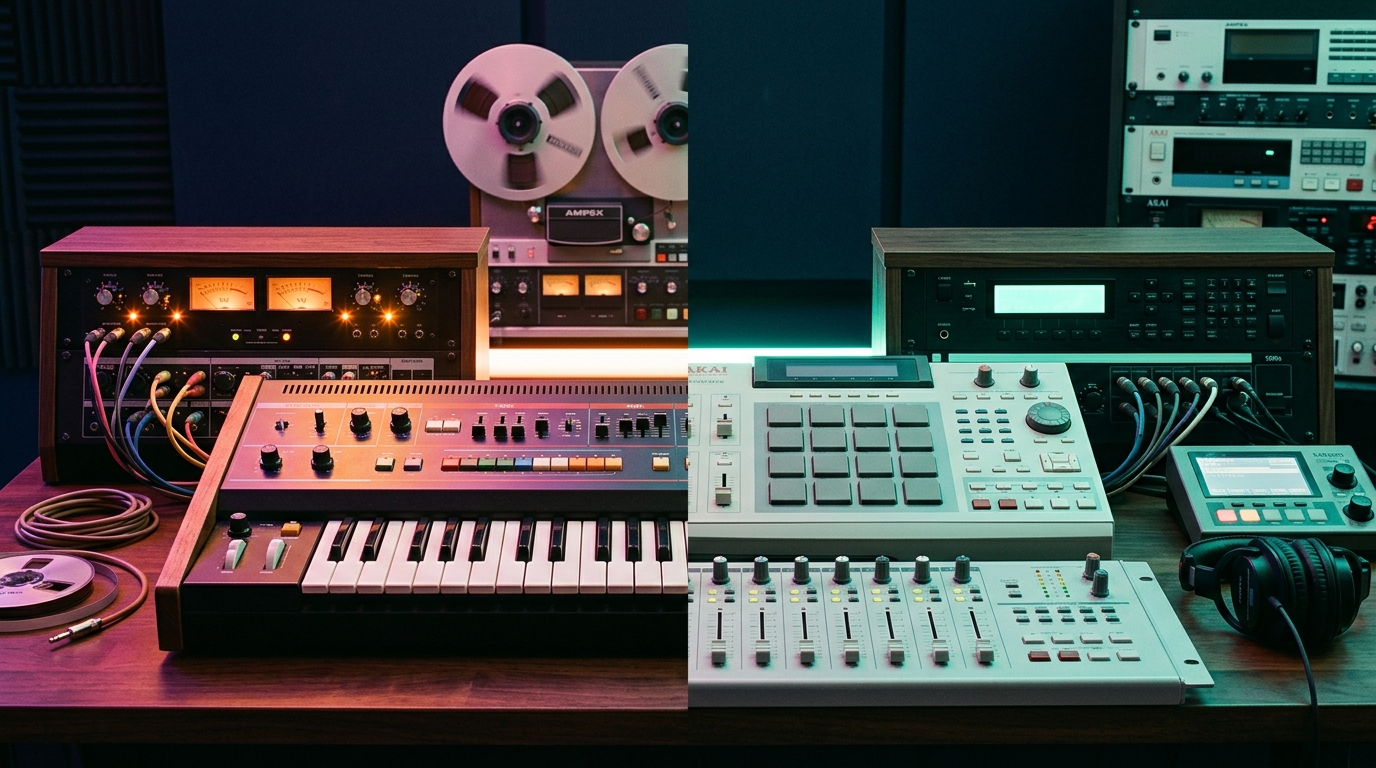
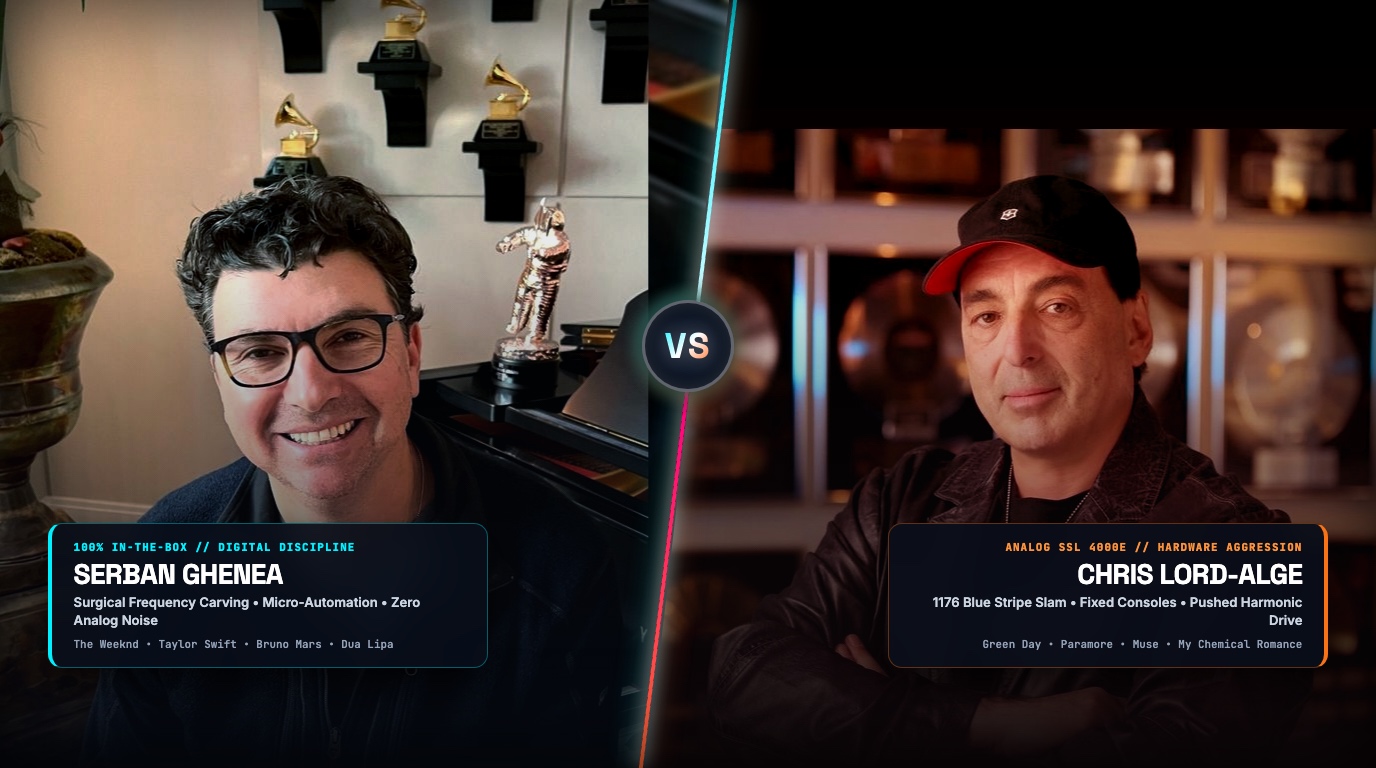
At first glance, 1990s bubblegum pop and 2010s hyperpop appear to exist in entirely different sonic universes. 90s bubblegum pop was the peak of corporate studio perfection: expensive Solid State Logic (SSL) 4000 series consoles, meticulously calibrated hardware exciters, multi-mic live drum tracking layered with pristine Roland JV-1080 sound modules, and vocal stacks comped syllable by syllable by legendary Swedish hitmaker Max Martin at Cheiron Studios. Every frequency pocket was scrubbed clean with surgical precision.
Hyperpop took those exact same euphoric, sugar-coated songwriting tropes and drove them straight off a digital cliff.
Pioneered by the London-based PC Music collective, producer A. G. Cook, SOPHIE, and later supercharged into abrasive American overdrive by 100 gecs (Dylan Brady and Laura Les), hyperpop did not reject 90s bubblegum pop. It worshipped it. Hyperpop producers realized that commercial pop was not too bright or too loud: it was not bright or loud enough. They took pristine pop hooks and deliberately pushed digital audio converters, extreme multiband OTT compression, and inter-sample peak folding into catastrophic, beautiful distortion.
This breakdown deconstructs the acoustics, signal chains, spectral curves, and mix mechanics behind both movements, featuring records by Aqua, Spice Girls, Britney Spears, Charli XCX, 100 gecs, and SOPHIE, complete with actionable DAW recipes you can use today.
1. The Converter War: Pristine Cheiron Polish vs. Calculated Digital Destruction
To understand why 90s bubblegum pop and hyperpop sound radically different, you have to look at the philosophy of the recording chain:
1990S BUBBLEGUM POP (THE HIGH-GLOSS ANALOG DESK):
Sony C800G Condenser Mic -> Neve 1073 Preamp & Tube-Tech CL1B Opto -> SSL 4000 Console (+8 kHz Air Shelf) -> Aphex Aural Exciter & SSL Bus Compressor -> Studer A827 Master Tape
result: Pristine vocal gloss, smooth optical levelling, and uncompressed 11 dB crest factor

HYPERPOP & PC MUSIC (THE CONVERTER CATASTROPHE ENGINE):
Native Digital Soft Synth / FM Engine -> Formant Pitch Shift (+3 to +7 Semitones) -> Xfer OTT Extreme Multiband Compression (150% Depth) -> Soft Clipper Smashed (+6 to +9 dB Over 0 dBFS)
result: Saturated square-wave folding, extreme harmonic brilliance, and aggressive sub-bass explosion
The 90s Cheiron Machine: The Science of Euphoria
In the mid-1990s, Swedish mastermind Denniz PoP and his protege Max Martin built Cheiron Studios in Stockholm into the most dominant pop production bunker on the planet. Working alongside Danish Eurodance teams like Aqua's producers Søren Rasted and Claus Norreen, they codified what we now know as bubblegum pop:
- Mathematical Song Architecture: Cheiron pop tracks were engineered like buildings. A new melodic element had to arrive every eight bars. The verse, pre-chorus, and chorus had distinct frequency roles. Nothing was allowed to clutter the vocal channel.
- The High-Shelf Exciter Sizzle: To make female vocalists and synthesized hooks cut through car radios and television broadcasts, engineers routed lead signals through the Aphex Aural Exciter. Rather than merely boosting existing treble, the exciter generated synthetic, pleasant second- and third-order harmonics between 5 kHz and 12 kHz, imparting a hyper-real, airbrushed sheen.
- The Pristine Low-End Cordon: In 90s Eurodance, kick drums were punchy 909 acoustic-hybrid samples centered tightly at 90 Hz, while basses were Roland JV-1080 or Juno-106 synth patches high-passed at 40 Hz. Sub frequencies below 35 Hz were eliminated to protect turntable styluses and conserve CD mastering headroom.
The Hyperpop Counter-Offensive: The Joy of Breaking Things
Two decades later, producers working under the PC Music banner looked at that same commercial glossy pop aesthetic and asked a dangerous question: What happens if we take every pristine element and push it so hard into the red that the digital converters scream?
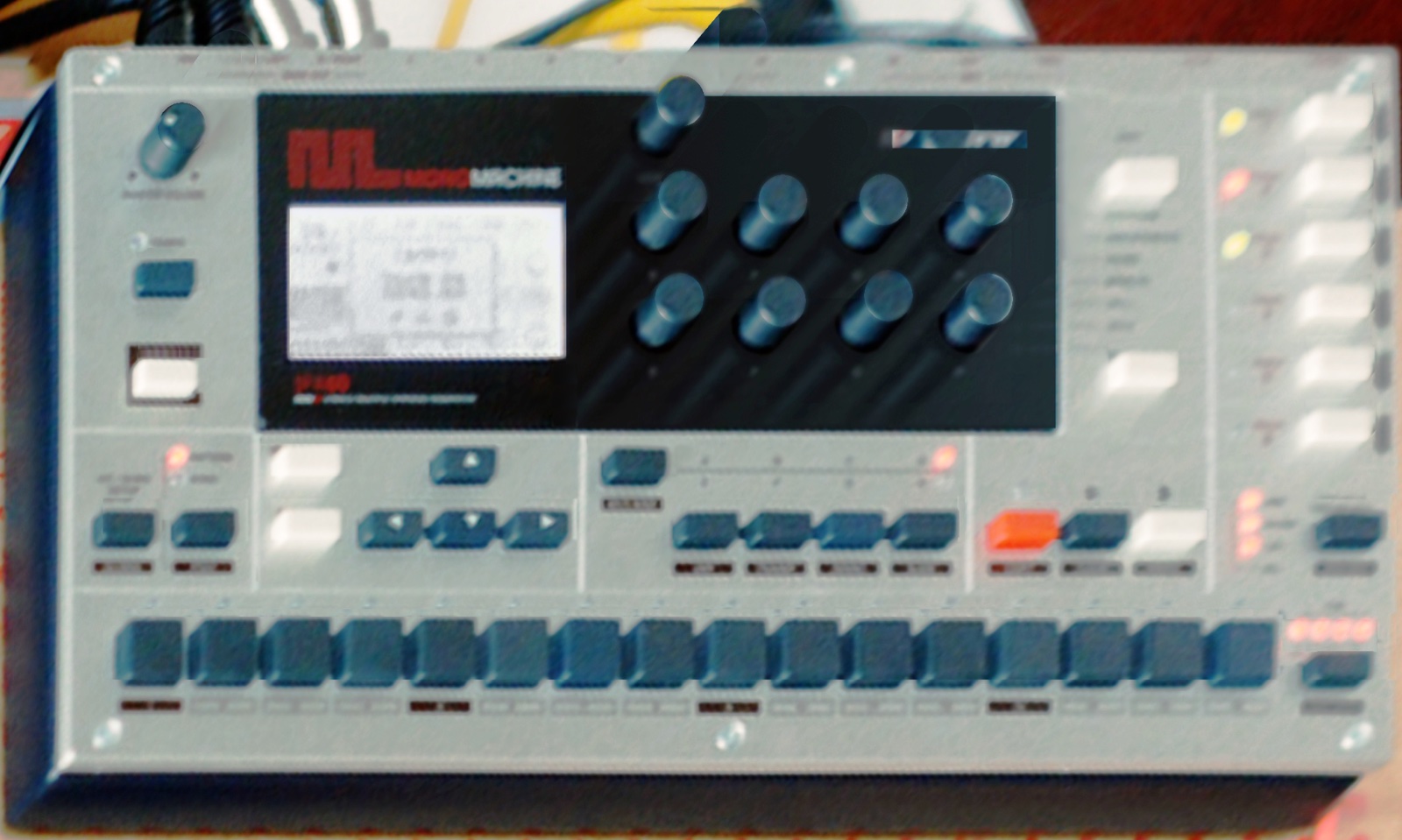
- SOPHIE's Physical Modeling Revolution: While traditional pop relied on sampled acoustic drums and warm analog synth patches, SOPHIE rejected sampling entirely. Working on the Elektron Monomachine, she synthesized every drum hit, metallic clang, and synthetic sweep from raw sine waves, frequency modulation (FM), and extreme envelope shaping. Her kicks did not just thump: they felt like laser-focused latex balloons popping under hydraulic pressure.
- OTT Multiband Obliteration: The free Xfer Records OTT plugin (an emulation of Ableton Live's Multiband Dynamics upward/downward compressor preset) became the sonic hallmark of the genre. By heavily boosting quiet details while clamping aggressive peaks, OTT dragged buried synthesizer harmonics and vocal breath noise straight to the front of the mix.
- The Clipper as a Distortion Pedal: Where 90s mastering engineers guarded the -0.1 dBFS ceiling with their lives, hyperpop producers like 100 gecs deliberately rammed sub-basses, snares, and vocal master buses 4 to 8 dB past 0 dBFS into soft clippers. The result was intentional square-wave foldback: jagged digital harmonics that sliced through iPhone speakers like a hot scalpel.
2. The Spectrum War: Interactive A|B Curves
The frequency divergence between 90s bubblegum pop and 2010s hyperpop reveals a fascinating story of converter headroom and dynamic range philosophy.
Use the interactive widget below to toggle between the pristine high-gloss curve of 90s Bubblegum Pop (Aqua, Spice Girls, Britney Spears) and the explosive converter-clipping response of Hyperpop (Charli XCX, SOPHIE, 100 gecs). Click the pins on the graph to jump directly to specific frequency breakdowns:
3. The Arsenal Matrix: Cheiron Studio Rig vs. Hyperpop DAW Factory
Every creative mixing choice is shaped by the physical limitations of the studio gear. Here is how the production pipelines compare across every key element:
| Production Dimension | 90s Bubblegum Pop (Cheiron / Eurodance) | 2010s Hyperpop (PC Music / 100 gecs) | The Engineering Difference |
|---|---|---|---|
| Core Synthesizers | Roland JV-1080, Yamaha DX7, Roland JD-800, Korg M1 | Elektron Monomachine, Serum, Ableton Operator FM, Native Instruments Massive | 90s pop relied on ROMpler sample playback modules; hyperpop synthesizes raw physical modeling and FM sweeps from scratch. |
| Vocal Production | 20+ manual vocal doubles, comped syllable by syllable on tape, tuned with early Antares Auto-Tune (1997) | Extreme formant shifting (+4 to +8 semitones), bitcrushing, pitch glides, and robotic robotic vocoding | 90s vocals aimed for hyper-human perfection; hyperpop vocals aim for cyborg alien hyper-reality. |
| Dynamics & Compression | Tube-Tech CL1B, Urei 1176, SSL G-Master Bus Compressor (2 to 4 dB gentle reduction) | Xfer OTT (extreme upward compression), multi-stage digital limiters | 90s pop used compression to glue elements together musically; hyperpop uses compression as an explosive timbral texture. |
| Distortion & Saturation | Subtle tape warmth via Studer A827 (1/2" tape @ 15 IPS) and Neve preamp second harmonics | Digital foldback distortion, bitcrushing to 8-bit, inter-sample peak clipping, guitar pedal overdrive | 90s distortion was hidden to maintain pristine commercial clarity; hyperpop distortion is the primary lead instrument. |
| Transient Architecture | Punchy acoustic kick beater + 909 clap with natural room ambience | Razor-sharp 5ms synthetic transient click sidechained into pure sine waves | 90s transients breathe with analog swing; hyperpop transients hit with mathematical sample-accurate rigidity. |
| Stereo Width | Tight center kick/bass/lead vocal, panning reserved for backing vocals and stereo synth delays | Ultra-wide Haas effect, stereo comb filtering, hyper-panned hi-hats, mono-incompatible side signals | Hyperpop exploits extreme stereo widening algorithms to make synths wrap 180 degrees around headphones. |
| Master Bus Peak Control | TC Electronic Finalizer or Prism Sound converters, clipping strictly avoided | Hard soft-clipping (AuxClip Pro or native DAW clippers) shaving 3 to 6 dB before master limiter | 90s mastering prioritized pristine crest factor; hyperpop uses soft clipping to achieve competitive, ear-splitting loudness without pumping. |
| Commercial Loudness Target | -10 to -8 LUFS (True Peak -0.3 dBFS) | -5 to -3.5 LUFS (Inter-sample peak distortion embraced) | Hyperpop records are among the loudest commercial audio files ever produced in digital recording history. |
4. The Studio Showdowns: 6 Benchmark Records
To experience how these engineering philosophies clash in practice, level-match your monitor controllers and use the timestamped listening cues below to dissect three legendary head-to-head showdowns.
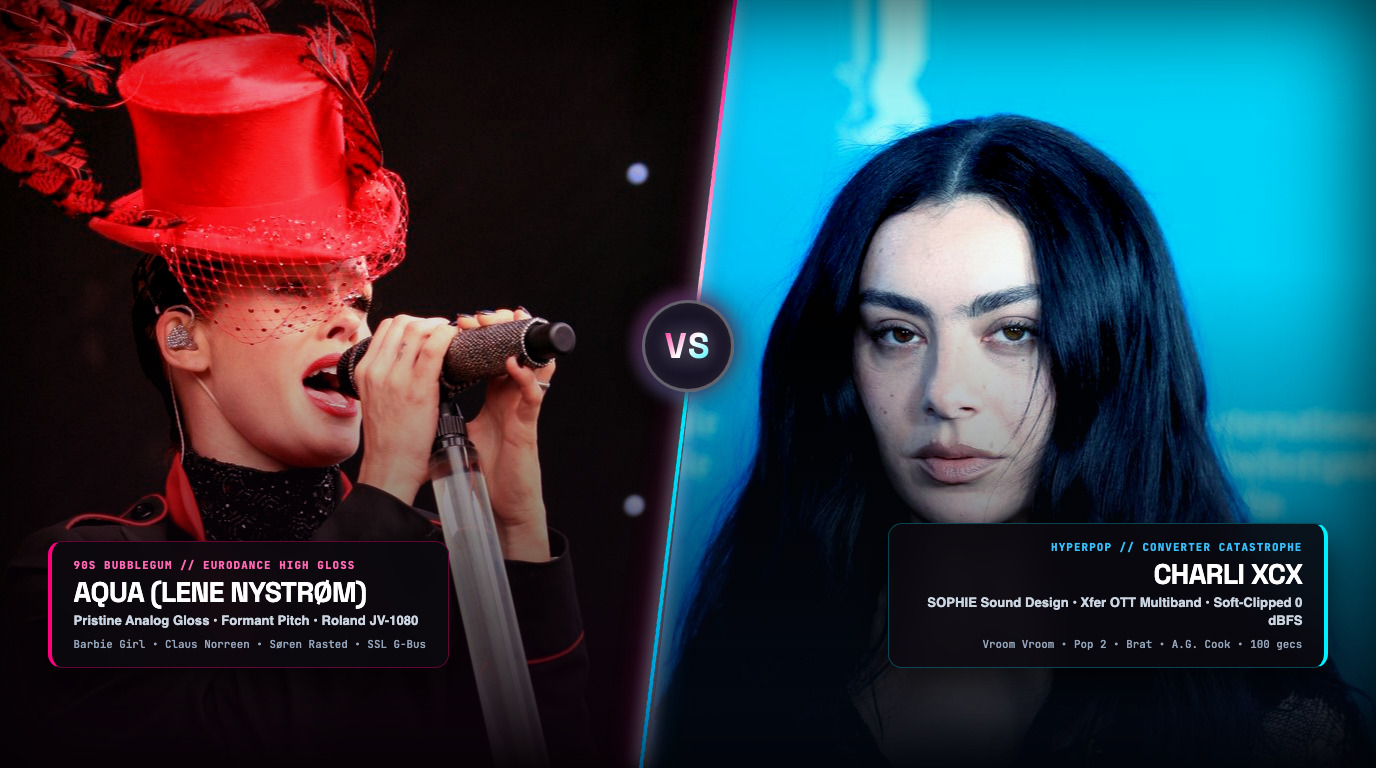
Showdown 1: Plastic Fantastic Camp vs. Industrial Pop Weaponry (Aqua vs. Charli XCX)
Plastic Formant Pitching vs. Titanium Metallic Sound Design
Contrast how Aqua's producers crafted pristine Europop perfection against how SOPHIE engineered Charli XCX's paradigm-shifting hyperpop manifesto.
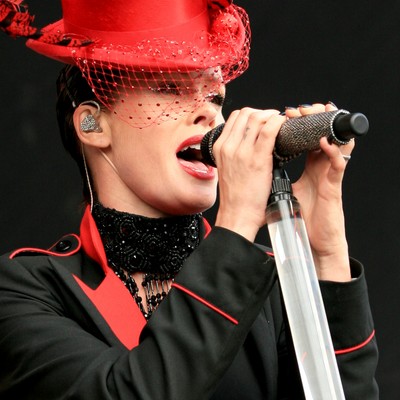
The undisputed holy grail of 90s Eurodance. Producers Søren Rasted and Claus Norreen engineered Aqua's international mega-hit with surgical precision. Lene Nystrøm's iconic high-pitched vocal was created by speeding up the tape and running her vocals through an Aphex Aural Exciter, giving her voice an unmistakable plastic doll sheen. Paired with René Dif's booming baritone in the center channel, the mix achieves breathtaking vocal separation over a bouncy, pristine 909-style drum loop.
- 0:00 The famous spoken intro ('Hi Barbie!'). Notice the hyper-clean vocal isolation: zero room ambience, pristine de-essing, and subtle stereo chorus.
- 0:14 The four-on-the-floor kick enters. It is tightly tuned around 90 Hz with zero sub mud below 40 Hz, leaving wide headroom for the staccato synth bassline.
- 0:45 The chorus vocal stack: listen to how Lene's pitch-boosted vocals sit dead-center, while bright Roland JV-1080 pizza-plucks sparkle in the stereo sides.

The track that fired the starting gun for the hyperpop movement. Produced by visionary Scottish artist SOPHIE for Charli XCX, 'Vroom Vroom' turns bubblegum pop tropes into razor-sharp industrial weapons. SOPHIE synthesized every mechanical screech, engine rev, and bubble pop using physical modeling synthesis on the Elektron Monomachine. The bass drop at 0:31 hits with terrifying sub-bass authority, while Charli's deadpan vocals hover inches from your ear through multi-stage OTT compression.
- 0:00 Charli's whispered vocal ('Lavender Lamborghini, roll up in a blue bikini'). Hear the extreme vocal proximity effect, clamped down with zero room reverb.
- 0:31 The drop explodes: a colossal, pure sine-wave 808 sub bassline collides with titanium synth screeches. Notice how clean the sub stays even as high frequencies clip aggressively.
- 1:33 The bridge: a sudden switch to euphoric, lush pop piano chords, parodying classic bubblegum sweetness before plunging back into abrasive mechanical drops.
Showdown 2: Euphoric Commercial Girl-Power vs. Deep-Fried Internet Mayhem (Spice Girls vs. 100 gecs)
Commercial Radio Perfection vs. Converter-Clipping Internet Madness
Discover how the Spice Girls' multi-layered analog vocal harmonies compare to 100 gecs' unhinged, square-wave bitcrushed masterpiece.
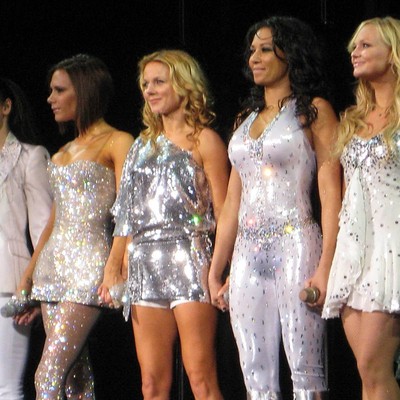
The highest-selling single by a female group in pop history. Produced by Richard Stannard and Matt Rowe and mixed by legendary mixer Mark 'Spike' Stent on an SSL 4000G console, 'Wannabe' by the Spice Girls is a masterclass in vocal choreography. Managing five distinct vocalists across a single fast-paced track required surgical EQ carving. Stent carved out dedicated midrange frequencies for Mel B, Geri Halliwell, Emma Bunton, Victoria Beckham, and Mel C, gluing them into a punchy, unstoppable party groove.
- 0:00 Mel B's iconic opening laugh ('Yo, I'll tell you what I want'). Notice the natural room sound and tape saturation that gives the voice immediate human punch.
- 0:30 The verse transition: listen to the interplay between the walking funky bass guitar and the staccato acoustic piano chords. Both sit tightly in the 200 Hz to 800 Hz pocket.
- 1:08 The explosive chorus: all five voices sing in unison. Rather than comb filtering, Stent pans individual doubles across the stereo field to create a massive wall of sound.

The explosive anthem that pushed hyperpop into mainstream consciousness. Produced and mixed by Dylan Brady and Laura Les of 100 gecs, 'money machine' is an engineering assault. Brady pitch-shifts Les's vocal upward by 7 semitones, then routes it through aggressive multiband distortion and OTT compression. The 808 sub drops into a deliberate, wall-to-wall soft clipper that folds the waveforms into squares, generating catastrophic inter-sample harmonics that sound like your headphones are melting.
- 0:00 Laura Les's pitch-shifted spoken monologue ('Hey, you lil' piss baby'). The vocal is pushed through extreme formant-shifting DSP and compressed into razor-sharp clarity.
- 0:19 The drop lands like an asteroid: an overblown, distorted 808 bassline pushes the master bus meter deep into the red. Notice the intentional crackling digital distortion on every kick transient.
- 0:48 The autotuned pop hook: despite the catastrophic distortion underneath, the vocal hook remains 100% intelligible, demonstrating masterful frequency pocketing.
Showdown 3: Pristine Cheiron Hit Factory vs. Physical-Modeling Trans Pop (Britney Spears vs. SOPHIE)
Surgical Vocal Comping vs. Liquid Plastic Synthesis
Analyze how Max Martin's legendary Cheiron production formula compares to SOPHIE's groundbreaking physical-modeling electronic sound design.
The single most influential pop track of the late 20th century. Written and produced by Max Martin and Rami Yacoub for Britney Spears, '...Baby One More Time' established the Cheiron sound. The track is built on iconic, staccato piano chords hit with aggressive SSL channel gating, leaving dramatic empty space before each drum hit. Britney's lead vocal features her signature vocal fry, automated word by word and layered with three octaves of whispered doubles to cut through radio compression with hypnotic power.
- 0:00 The legendary 3-note piano hook ('Da-na-na!'). Notice the hyper-dry gating: the moment the chord ends, the reverb is choked off into dead silence.
- 0:10 Britney's vocal fry enters ('Oh baby, baby'). The vocal is compressed through an 1176 in parallel, pulling forward every intimate breath and lip sound.
- 1:10 The massive chorus: listen to the bassline. It's a synthesized electric bass clone layered with a sub sine that ducks on every downbeat kick, anticipating modern EDM sidechaining.

A euphoric, transcendent electronic pop masterpiece. From her Grammy-nominated album Oil of Every Pearl's Un-Insides, SOPHIE created 'Immaterial' as an ode to identity and boundless sonic freedom. Rather than using conventional drum kits, SOPHIE synthesized every percussion element using high-frequency FM bursts that mimic bouncing rubber and stretching plastic. The vocal is pitched into an angelic, hyper-femme register, floating effortlessly over a relentless, joyously clipped four-on-the-floor kick drum.
- 0:00 The bouncy plastic bassline: synthesized entirely from sine waves with high-speed pitch decay envelopes, creating the illusion of elastic rubber bouncing in space.
- 0:45 The vocal hook ('I was just a lonely girl... Immaterial girls!'). Notice the hyper-bright vocal sheen at 10 kHz, sitting smoothly without harsh sibilance thanks to dynamic resonance carving.
- 2:30 The final crescendo: SOPHIE pushes the master limiter to -4.5 LUFS while keeping individual synth stems pristine, proving that extreme loudness does not require sacrificing musicality.
5. Producer Playbook: Recreating Both Eras
You do not need a vintage SSL console or a rare hardware synth to capture either aesthetic. Here are five practical DAW recipes to recreate 90s bubblegum gloss and explosive hyperpop sound design inside your project today.
Theme 1: The Cheiron Vocal Stack vs. Extreme Formant-Pitch Automation
The 90s Cheiron Vocal Formula
- Track 5 Distinct Passes: Record 1 lead center vocal, 2 tight unison doubles (panned 60% left and right), and 2 octave-up whisper doubles (panned 100% left and right).
- Apply High-Shelf Excitement: On each vocal track, insert a high-shelf EQ at 8 kHz and boost by +3.5 dB. Follow with an optical compressor (like a CL1B or LA-2A emulation) catching 2 to 3 dB of peak reduction.
- The Gated Slap Delay: Send the vocal bus to an auxiliary return with a 1/16th-note mono tape delay. Insert a noise gate after the delay keyed to the lead vocal: the moment the singer stops singing, the delay cuts off abruptly, creating that hyper-clean, radio-ready finish.
The Hyperpop Cyborg Formant Formula
- Formant Shift Upward: Insert a dedicated formant processor like AuxFormant or native DAW pitch shifter. Shift the Formant parameter up by +4 to +7 semitones while leaving the fundamental musical pitch unchanged. This transforms a normal adult vocal into an animated, hyper-gloss character without altering the key of the track.
- Auto-Tune Speed Zero: Set your pitch correction plugin to Retune Speed 0 (or instant hard snapping) set to your project's exact scale.
- The OTT High-Frequency Sandwich: Place Xfer OTT immediately after the pitch shifter. Set Depth to 65%, Time to 100%, and drag the High band upward expansion threshold down to pull out extreme breath and sibilant sizzle.
Theme 2: The Plastic Eurodance Pluck vs. The SOPHIE Metallic Clang
The 90s Roland JV-1080 Pizza-Pluck
- Sound Source: Load a bright, sample-based pizzicato string or marimba patch (or a JV-1080 emulation).
- Filter Envelope: Set the low-pass filter cutoff to 1.2 kHz with an envelope decay of 120 ms and zero sustain.
- Stereo Chorus: Insert a vintage bucket-brigade stereo chorus (Rate: 0.8 Hz, Depth: 45%). Pan the pluck 30% to the right, and send 20% to a bright plate reverb with a 1.2-second decay.
The SOPHIE Liquid Metal Synthesis
- FM Modulation: In any FM synth (Ableton Operator, Serum, or Dexed), set Carrier Oscillator A to a pure sine wave. Set Modulator Oscillator B to a sine wave tuned at a non-integer harmonic ratio (e.g. 2.73x).
- Fast Pitch Drop: Modulate the pitch of Oscillator A with a dedicated pitch envelope dropping by +24 semitones over just 8 milliseconds. This produces a percussive, metallic transient "clink" that sounds like a steel ball hitting glass.
- Comb Filtering & Short Delay: Add a comb filter tuned to 440 Hz with high resonance, followed by a stereo delay with 5 ms on the left and 9 ms on the right (the Haas effect). The sound will snap out of your speakers with industrial, three-dimensional realism.
Theme 3: Analog Tape Exciter Air vs. Catastrophic Square-Wave Clipping
The 90s Cheiron Air Bus
- Exciter Harmonic Injection: On your instrument bus, insert an exciter plugin. Dial in 15% second-order harmonic saturation focused strictly on frequencies above 6 kHz.
- Tape Compression: Send the master bus through a 1/2-inch analog tape emulation running at 15 IPS (inches per second). The slower tape speed naturally softens harsh cymbal transients while adding a warm low-end bump at 60 Hz.
The Hyperpop Soft-Clipper Decimation
- Pre-Master Soft Clipping: Place a dedicated soft clipper plugin like AuxClip Pro as the very last plugin on your drum bus and pre-master before the final limiter.
- Drive into 0 dBFS: Push the input gain into the clipper by +3 to +6 dB. Because soft clippers use polynomial saturation curves rather than hard digital truncation, they round off transient spikes into musical square-wave harmonics. You gain 3 dB of immediate commercial loudness without the dull, lifeless pumping caused by aggressive limiters.
Theme 4: Stereo Bus Separation vs. Multiband OTT Hyper-Compression
The 90s Surgical Pan Architecture
- The Sacred Center: Kick drum, snare fundamental (200 Hz), bassline, and lead vocal remain in pure mono.
- The Peripheral Stereo Field: Backing vocals are double-tracked and hard-panned 100% left and right. Roland synth pads and stereo delay returns fill the 50% to 80% panning zones. This preserves flawless mono compatibility when broadcast over FM mono clock radios.
The Hyperpop Multiband Wall
- Mid/Side Stereophonic Splitting: High-pass the Side channel of your sub-bass at 120 Hz to keep sub rumble mono, but apply extreme stereo chorus and Haas delays to everything above 1 kHz.
- The 150% OTT Squeeze: Place OTT across synth pads and lead guitars. Crank the Upward Compression parameter so that quiet reverberant tails are boosted by +18 dB, creating a hyper-compressed, suffocatingly dense wall of sound.
Theme 5: The Loudness Paradox (Analog Headroom vs. Modern Converter Folding)
- 90s Bubblegum Target: -10 to -8 LUFS with a dynamic crest factor of 9 to 11 dB. The punch comes from the physical jump in volume between a quiet verse and an explosive, full-frequency chorus.
- Hyperpop Target: -5 to -3.5 LUFS with a crest factor of 3.5 to 5 dB. Because dynamic range is flattened, energy is created through timbral automation: sudden drops into mono, sudden cuts to dead silence, and violent bursts of stereo noise.
6. The Producer Cheat Sheet: 90s Bubblegum Rules vs. Hyperpop Rules
| Parameter | 90s Bubblegum Pop Rules | Hyperpop Production Rules |
|---|---|---|
| Kick Drum | 909 sample tuned to 90 Hz, high-pass below 40 Hz | 5ms transient click + separate tuned 35 Hz sub sine wave |
| Snare / Clap | Layered acoustic snare + 909 clap with plate reverb | Laser-thin synthetic 808 clap, zero reverb, clipped to 0 dBFS |
| Vocal Treatment | Natural pitch comping, Aphex air exciter, 1/16th gated delay | Formant shift (+5 st), hard Auto-Tune, OTT multiband boost |
| Bassline | Roland JV-1080 sync bass or Juno-106 staccato pluck | Distorted 808 sub sine wave with pitch glide portamento |
| Synthesizers | Clean ROMpler piano, marimba plucks, bright brass | Custom FM metallic clanks, physical modeling, detuned supersaws |
| Dynamics | Gentle 2:1 opto compression, transparent tape saturation | Extreme upward/downward OTT compression, foldback distortion |
| Stereo Field | Strict mono center, stereo reserved for doubles & delays | Extreme Haas widening, stereo comb filtering, hyper-panned hats |
| Master Ceiling | Conservative -0.3 dBFS true peak, zero digital clipping | Soft clipping 4 to 8 dB over 0 dBFS, inter-sample peaks embraced |
7. The Modern 2026 Hybrid: Hyper-Gloss Pop Production
The most exciting pop records of 2026 do not choose between 90s bubblegum gloss and hyperpop distortion: they fuse them into a cohesive hybrid. Artists like Charli XCX on Brat, PinkPantheress, and modern dance-pop producers combine the irresistible melodic hooks of Cheiron Studios with the cutting-edge sound design of PC Music.
Here is the exact 4-step pipeline to build this hybrid in your DAW:
THE 2026 HYPER-GLOSS POP HYBRID PIPELINE:
Phase 1: 90s Cheiron Melodic Bed (Four-chord diatonic progression with clean piano & Roland JV plucks) -> Phase 2: Vocal Formant Layering (Lead vocal center blended with +3.5 semitone formant double) -> Phase 3: FM Metallic Accentuation (High-pass FM layer >2 kHz with resonant comb filtering) -> Phase 4: Staged Peak Clipping (AuxClip Pro shaving 2.5 dB transients before transparent limiter)
result: Fuses irresistible 90s bubblegum pop vocal clarity and melody with cutting-edge hyperpop harmonic energy
Step 1: Write an Irresistible 90s Bubblegum Melodic Hook
Start by writing a four-chord, diatonic progression using a clean, dry piano or Roland JV-style plucked synth. Keep the tempo between 128 and 138 BPM. Ensure your top-line vocal melody has clear question-and-answer phrasing with an infectious rhythmic bounce.
Step 2: Pitch and Formant-Shift the Lead Vocal
Duplicate your lead vocal track:
- Leave Vocal A natural and dead-center.
- On Vocal B, insert AuxFormant and shift the formant up by +3.5 semitones. Pan Vocal B 50% left and right in stereo.
- Blend Vocal B approximately -8 dB underneath Vocal A. You will instantly achieve the modern, hyper-gloss pop vocal sheen that cuts through any mix without sounding cartoonish.
Step 3: Layer FM Metallic Accents Behind Eurodance Plucks
Take your classic bubblegum chord plucks and layer a high-frequency FM synthesizer patch underneath. Filter out everything below 2 kHz on the FM patch and dial in high-resonance comb filtering. This injects the signature SOPHIE metallic texture on top of a warm, nostalgic musical bed.
Step 4: Shave 2.5 dB with Soft Clipping Before Limiting
Insert a dedicated soft clipper plugin like AuxClip Pro directly before your master bus limiter. Drive the mix bus into the clipper until you see 1.5 to 2.5 dB of soft peak shaving on the transient peaks. Follow with your master limiter set to catch no more than 1 dB of gain reduction.
Your mix will emerge with commercial loudness, deep sub-bass authority, and the euphoric, crystalline gloss of 90s bubblegum pop pushed to its logical breaking point.