
Put a 1984 pop record and a 1998 pop record side by side in your DAW, level-match their volumes, and the sonic contrast is staggering.
An 1980s pop mix feels like standing in the middle of a neon-lit sports arena. The drums crack like lightning, synths shimmer like crystal bells, and the vocals soar through cavernous halls. The low end is clean, nimble, and polite, leaving massive headroom for the snare drum and lead vocal to leap out of your speakers.
A 1990s pop mix feels like sitting in the front seat of a car with two 12-inch subwoofers in the trunk. The sub-bass shakes your ribcage, the kick and snare smack you right in the forehead, and the vocals are pushed so close to your ear they feel like an intimate whisper.
Why do these two decades sound so radically different? It was not just a change in musical taste. It was a revolution in recording technology, delivery formats, and acoustic physics.
Whether you are looking to capture vintage 80s nostalgia, build punchy 90s hip-hop/pop grooves, or understand how modern hits borrow from both eras, this breakdown unpacks the exact instruments, frequency curves, and mixing recipes behind both worlds.
1. The Mechanical Truth: How Formats Forced the Sound
The biggest misconception producers have about vintage eras is assuming that 80s and 90s mixes sounded different purely because people changed their taste in clothes and synthesizers.
In audio engineering, the playback medium always dictates the mix. Here is the plain-English breakdown of why each era sounded the way it did:
The 1980s: The Vinyl, Tape, and FM Radio World
- The Vinyl Needle Problem: In the 1980s, vinyl records and analog cassettes were still major consumer formats. A vinyl record works by dragging a physical diamond needle through a spiral groove. If an engineer put too much heavy sub-bass (frequencies below
50 Hz) onto the record, or made the bass stereo, the needle would physically bounce out of the groove and skip across the record! To protect listeners' turntables, mixing engineers used high-pass filters around35 Hz - 45 Hzand focused bass punch higher up in the upper bass (80 Hz - 140 Hz). - The Brand-New Digital Reverb Toybox: Digital reverbs like the Lexicon 224 and AMS RMX16 were revolutionary inventions in the 1980s. For the first time, producers could add massive, lush, unnatural hall and gated-room spaces at the press of a button. They used these effects proudly as loud, featured instruments.
- Huge Dynamics (Crest Factor): "Crest factor" is simply the volume difference between the average body of a song and its loudest transient peaks (like the snare drum hit). In the 80s, this gap was huge (typically
13 dB to 16 dB). The music could breathe: verses were gentle, and the chorus exploded with dynamic power.
The 1990s: The 16-Bit CD, Hip-Hop Samplers, and the Loudness War
- The CD Revolution Unleashes the Subwoofer: By the early 1990s, the 16-bit Compact Disc (CD) had taken over. Because a CD is read by a laser beam rather than a physical diamond needle, there were zero mechanical limits on bass. Producers could blast pure, earth-shaking sub-bass all the way down to
30 Hz. Hip-hop producers sampling the Roland TR-808 and Akai MPC samplers pushed pop music down a full octave into the40 Hz - 60 Hzzone. - Dry, In-Your-Face Vocals: Because 90s arrangements became packed with dense synth layers, sample loops, and multi-tracked vocal harmonies, huge 80s reverb tails would have turned the mix into pure mud. Engineers dialed back the reverb, swapped long halls for short early reflections and stereo micro-pitch widening, and pushed the dry lead vocal right up against the listener's eardrums.
- The Loudness War Begins: In 1994, digital brickwall limiters (like the Waves L1 plugin and hardware digital processors) hit major studios. Suddenly, labels and radio stations wanted every CD to sound louder than the last one. Engineers began squeezing the dynamic range down (crest factors shrank to
8 dB to 10 dB), making 90s pop punchy, dense, and instantly loud.
2. The Spectrum War: Interactive A|B Curves
Below is the Long-Term Average Spectrum (LTAS) tonal balance comparison between benchmark 1980s pop masters and 1990s pop masters, normalized against a flat pink-noise reference.
How to Read This Graph
- The X-Axis (Left to Right): Shows pitch from the deepest subwoofer rumble (
30 Hz) on the left, through the musical midrange (500 Hz - 2 kHz), up to sparkling air (16 kHz) on the right. - The Y-Axis (Up and Down): Shows how loud that specific frequency band is relative to a balanced reference.
- Interactive Controls: Click the buttons in the top-right corner to view both curves together, isolate the 80s Curve or 90s Curve, or click Delta (B - A) to see the exact EQ difference (what was boosted or cut in the 90s). Click any numbered pin on the graph to jump directly to its breakdown.
3. The Gear Arsenal: Hardware DNA Matrix
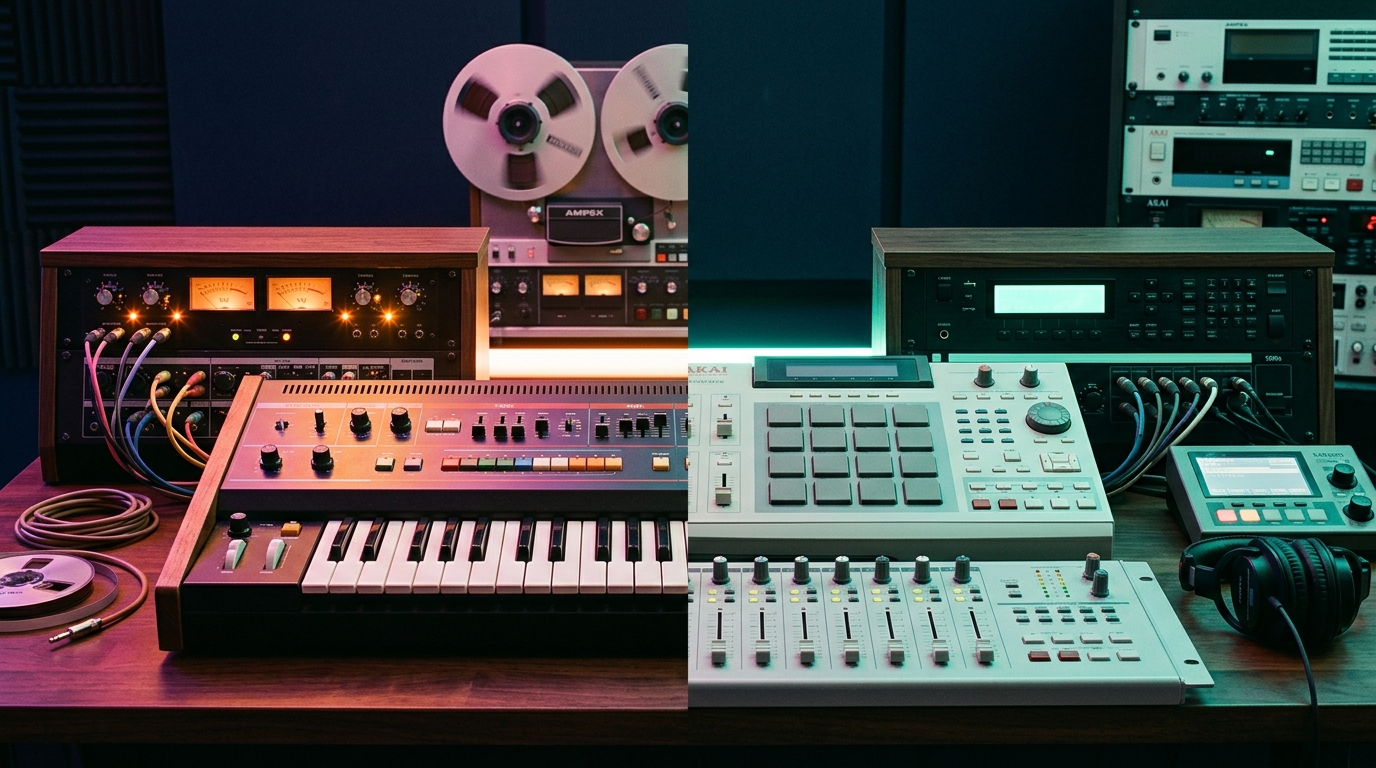
When you strip down a classic track, you are hearing a specific family of synthesizers, drum machines, and processors. Use this guide to identify the signature sound sources of each era:
| Mix Element | 1980s Pop Standard | 1990s Pop Standard | What This Means For Your Ears |
|---|---|---|---|
| Drums & Percussion | Linn LM-1 / LinnDrum, Oberheim DMX, Roland TR-707/TR-808, Simmons electronic toms. | Akai MPC60 / MPC3000, E-mu SP-1200, Roland TR-909 (dance/house), layered acoustic breakbeats. | 80s drums have wide, explosive gated reverb tails and a bright upper-mid crack (2.5 kHz). 90s drums are bone-dry, hard-clipped, and swung with a groovy hip-hop/R&B bounce. |
| Bass Architecture | Minimoog Model D, Yamaha DX7 (E.BASS 1 FM preset), Roland Juno-60, chorus-soaked electric slap bass. | Roland JV-1080 / JD-990, Korg M1 (Organ 2 bass), deep sine wave sub oscillators, 5-string active electric bass. | 80s bass relies on bright buzz and slap (90 Hz - 250 Hz) so it can be heard on tiny speakers. 90s bass dominates 40 Hz - 60 Hz with pure, heavy chest rumble. |
| Keys & Synths | Yamaha DX7 (sparkling FM electric pianos and chime bells), Roland Jupiter-8, Oberheim OB-Xa (epic brass stabs). | Korg M1 (01: Universe, 16: Piano 16'), Roland JV-1080 / XP-80 (pizzicato strings, nylon guitars), Kurzweil K2000. | 80s synths are raw analog oscillators or FM digital chimes treated with lush chorus pedals. 90s synths are sample-based workstations (ROMplers) with built-in digital effects. |
| Guitars | Clean Stratocaster plugged directly into a Roland Jazz Chorus (JC-120) amp with heavy chorus and compression. | Acoustic guitars strummed hard and panned hard Left and Right, or muted funk-guitar wah scratches. | 80s clean guitars shimmer in the upper-mids (2 kHz - 5 kHz). 90s pop uses crisp acoustic guitar strumming as a rhythmic layer that acts almost like a stereo hi-hat. |
| Lead Vocal Chain | Neumann U87 or dynamic mics -> warm tube preamp -> UREI 1176 compressor -> EMT plate reverb with a long pre-delay. | Sony C800G or Neumann U87 -> Avalon VT-737sp tube channel strip -> Tube-Tech CL 1B compressor -> Eventide micro-pitch widener. | 80s vocals sit inside an epic, three-dimensional concert hall. 90s vocals are hyper-compressed, whispered right against your ear, and layered into a 12-track stereo choir in the chorus. |
| Reverb & Space | Lexicon 224XL / 480L, AMS RMX16 (gated room reverb), Roland Dimension D chorus. | Eventide H3000 (micro-pitch widening), Lexicon PCM70, short room ambience, tempo-synced stereo delays. | 80s space is about front-to-back depth (huge 2-to-3 second reverb decays). 90s space is about left-to-right width (short ambience and pitch widening that keeps the center punchy and dry). |
| Master Bus Processing | Mixing consoles (Harrison, Neve, SSL 4000) printing to 1/2-inch analog tape at 30 ips. | SSL G-Series Bus Compressor -> modern digital brickwall peak limiters (Waves L1). | 80s masters round off sharp peaks with gentle analog tape warmth. 90s masters use VCA bus glue and digital limiters for maximum competitive loudness. |
4. The Studio Showdowns: 6 Benchmark Records
To hear how these production decisions play out in legendary commercial releases, we paired six landmark records across three classic mixing challenges. Press play on the embedded Spotify players and listen for the timestamped cues below each track.
Showdown 1: The Low-End Heist (Michael Jackson vs. TLC)
How do you lock a kick drum and bassline together so the groove feels massive without burying the vocal? Compare Bruce Swedien's clean, high-headroom analog separation on Michael Jackson's "Billie Jean" against Organized Noize and Neal H. Pogue's deep, warm R&B sub-bass on TLC's "Waterfalls".
Michael Jackson - 'Billie Jean' (1982) vs. TLC - 'Waterfalls' (1994)
Contrast how 1982 analog transient punch and high headroom differs from 1994 deep sub-bass weight and laid-back R&B pocket.
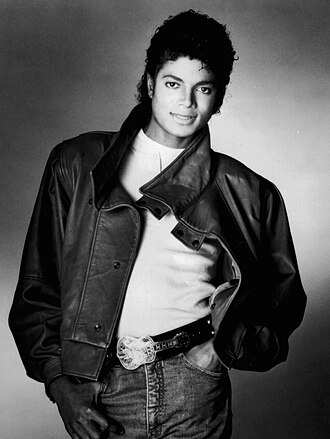
Legendary engineer Bruce Swedien mixed Billie Jean 91 times before Quincy Jones told him to go back to Mix #2. The magic of this rhythm track is clean separation. Swedien put a custom zippered moving blanket and a heavy cinder block on drummer Ndugu Chancler's bass drum to eliminate all room ring. This gave the kick a tight, papery thump focused around 95 Hz and 3.2 kHz with almost zero rumble below 45 Hz. That left a clean, open frequency pocket for Louis Johnson's bouncing bassline to rule the 70 Hz - 160 Hz zone. Notice how dry the center is: the kick, snare, and bass sit bone-dry in the middle, while Jackson's vocal and finger-snaps echo in a wide, three-dimensional acoustic space.
- 0:00 - 0:19 Dry Center vs. Wide Space: Listen to the solo drums for the first two bars. The kick and snare are completely dry, crisp, and center-focused. When the shaker enters at
0:05, it is panned wide with early reflections, establishing stereo width before the bass even enters. - 0:19 - 0:28 Punchy Upper-Bass Focus: When the bassline and Prophet synth stabs drop in, notice there is no deep
35 Hzsubwoofer shake. All the groove comes from tight, articulate notes between80 Hz and 140 Hz. - 1:08 - 1:25 The Acusonic Vocal Stack: In the pre-chorus ('People always told me...'), Jackson's background vocal harmonies were recorded at varying distances from the mic and panned across the stereo field, keeping the dead-center open for the lead.
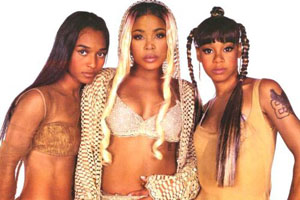
Where Billie Jean achieves its punch through quick transients and light sub-bass, Waterfalls achieves its power through deep sub-octave warmth. Produced by Organized Noize and mixed by Neal H. Pogue on an SSL 4000 G console, the drum foundation combines a crunchy, slightly bit-reduced SP-1200 snare rimshot with a deep, round kick drum centered down at 52 Hz. Underneath, bassist LaMarquis Jefferson plays a live 5-string electric bass whose lowest notes dip into the 40 Hz sub zone during the chorus. To stop that heavy low end from swallowing T-Boz's husky contralto vocal (180 Hz - 400 Hz), Pogue scooped out the lower midrange around 300 Hz in the keyboards and boosted the crisp vocal air band (10 kHz - 14 kHz).
- 0:00 - 0:22 Instant Sub-Bass Gravity: Compare the first kick and bass notes at
0:11directly against Billie Jean. The fundamental energy sits an entire octave lower (45 Hz - 55 Hz), creating an immediate, warm physical rumble in your headphones. - 0:23 - 0:45 Dry, Upfront Lead Vocal: T-Boz's verse vocal has almost zero audible room reverb. Instead, heavy tube/optical compression brings every quiet breath and lip sound right to the front of the speaker plane.
- 1:08 - 1:31 The Wall-of-Vocals Chorus: When the chorus lands ('Don't go chasing waterfalls'), dense multi-tracked vocal harmonies lock with the live bass and horns into the SSL bus compressor, creating a unified, glued soundstage.
Showdown 2: The Chorus Deathmatch (Whitney vs. Britney)
What happens when a pop song explodes into its biggest hook? In 1987, Narada Michael Walden and engineer David Frazer built Whitney Houston's "I Wanna Dance with Somebody" with bright FM bells, Simmons electronic toms, and an uncompressed, soaring vocal in a giant Lexicon hall. Eleven years later, Max Martin and Denniz Pop at Cheiron Studios revolutionized pop mixing on Britney Spears' "...Baby One More Time" using hard-clipped drum samples, an earth-shattering sub-drop, and a wall of hyper-compressed vocal layers.
Whitney Houston - 'I Wanna Dance with Somebody' (1987) vs. Britney Spears - '...Baby One More Time' (1998)
Compare 1987 FM synth brightness and gated-hall space against 1998 Swedish Cheiron Studios brickwall density.
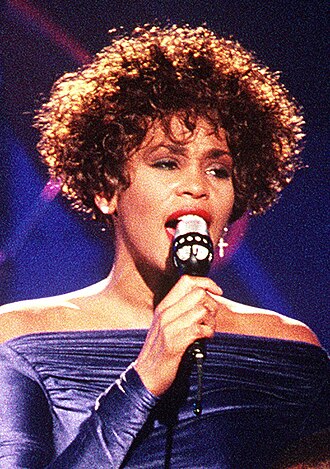
Mixed by David Frazer at Tarpan Studios, I Wanna Dance with Somebody is the textbook definition of bright, wide, high-headroom 80s pop. The track is unapologetically bright: generous high-frequency shelf boosts above 6 kHz lift the DX7 bells, 808 cowbells, and hi-hats, while the low end below 60 Hz is kept lean and tidy. Why doesn't it hurt your ears? Because the dynamic range is huge (over 14 dB crest factor) and the midrange (400 Hz - 1.2 kHz) is kept clear for Whitney Houston's vocal. Frazer used a long pre-delay (~65 ms) on Houston's Lexicon reverb: her dry voice hits you crystal-clear first, and then the giant stadium reverb blossoms smoothly behind her.
- 0:00 - 0:18 Stereo Simmons Tom Fills & 808 Cowbell: Notice how wide the electronic tom fills pan across the speakers, and how uncompressed the initial drum hit feels compared to modern pop.
- 0:49 - 1:10 The Pre-Delayed Reverb Bloom: In the space right after Whitney sings 'With somebody who loves me', you can clearly hear a
2-seconddigital reverb tail decaying naturally into the mix. - 3:55 - 4:30 Key Modulation Dynamic Freedom: When the song modulates up a semitone, Houston belts at full vocal power without triggering a master bus limiter. The backing tracks remain open and un-squashed.

Crafted at Cheiron Studios in Stockholm, ...Baby One More Time created the modern pop mixing blueprint. Listen to those iconic three opening piano/guitar stabs: they are heavily compressed and followed immediately by a jaw-dropping 45 Hz sub-bass drop that would have thrown a 1984 vinyl needle off the record. The kick drum is clipped and layered with a sub-bass thump, while the snare is combined with a crisp handclap. Britney's vocal is compressed aggressively through multiple stages, pinning her quiet, breathy vocal fry in the verse at the exact same perceived loudness as the 12-track choir stack in the chorus.
- 0:00 - 0:06 The Signature Cheiron Sub Drop: Right on the third opening chord (
0:02), feel the massive45 Hzsub-bass dive and the hard-clipped snare punch. The dynamic ceiling is locked down from the very first bar. - 0:15 - 0:34 Intimate Vocal Fry Compression: In the verse, Britney's breathy, quiet vocal consonants (
2.5 kHz - 7 kHz) are boosted and pinned right against your ear with almost zero audible room reverb. - 0:50 - 1:12 The Multi-Tracked Chorus Wall: In the chorus, Max Martin's own high-harmony backing vocals are blended behind Britney, widened with stereo pitch-shifting, and locked into the beat with acoustic guitar strums.
Showdown 3: The Space War (Prince vs. Madonna)
How do you make a dance record sound colossal? Compare Prince and Peggy McCreary's fearless, bassless 80s analog minimalism on "When Doves Cry" against Shep Pettibone and Goh Hotoda's driving 90s house piano, rolling sub-bass, and 3D QSound spatial panning on Madonna's "Vogue".
Prince - 'When Doves Cry' (1984) vs. Madonna - 'Vogue' (1990)
How Prince's bassless LinnDrum + gated-reverb minimalism evolved into Madonna's Korg M1 house piano, deep sub-bass, and QSound 3D panning.
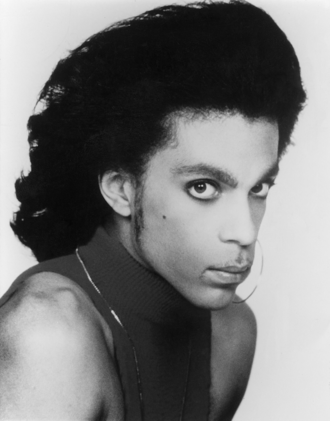
Just before mastering at Sunset Sound, Prince made one of the boldest mixing choices in pop history: he completely muted the bass guitar track. Because there is zero bass occupying the 50 Hz - 150 Hz frequency zone, the Linn LM-1 kick drum and pitched cross-stick pattern sound huge without needing any low-end boost. Every element has its own isolated room: the dry LinnDrum beat anchors the center, the screaming opening guitar solo echoes through Sunset Sound's tiled live chamber, and Prince's double-tracked vocals (baritone chest voice layered with a high falsetto) provide a haunting, theatrical stereo spread.
- 0:00 - 0:16 Wet Echo Guitar into Bone-Dry Drums: The track starts with a screaming guitar solo drenched in Sunset Sound's live chamber, then cuts abruptly to a dry, pitched-down Linn LM-1 cross-stick loop with zero bass underneath.
- 0:32 - 1:05 The Octave Vocal Trick: Listen to how Prince layers a low chest voice and a high falsetto panned across the stereo field. The song sounds thick and full purely through musical arrangement rather than heavy bus compression.
- 2:25 - 3:15 Analog Synth Fanfares: Bright Oberheim OB-Xa brass synths fill the upper midrange (
800 Hz - 3 kHz), while the low end stays open and clear.
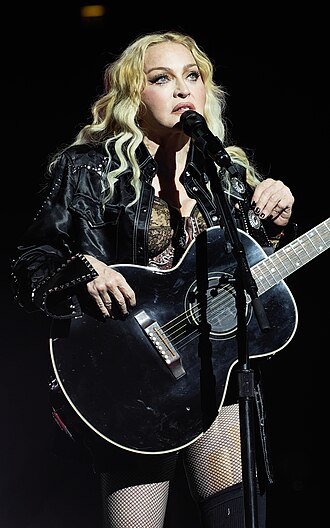
Released in 1990, Vogue is the exact bridge between the two decades. Producer Shep Pettibone built the rhythm around the Roland TR-909 drum machine and the Korg M1 synthesizer (the iconic percussive house piano chords paired with an 'Organ 2' bassline). Mix engineer Goh Hotoda mixed the song using QSound, an early 3D audio phase processor. On speakers or headphones, the finger snaps, orchestra hits, and spoken rap lines seem to wrap completely around the sides of your head, far outside the physical speaker positions, while the 909 kick (55 Hz) stays rock-solid in the center.
- 0:00 - 0:38 The 3D QSound Width: Listen to the finger snaps, brushed snare rolls, and orchestral string hits in the intro. Subtle phase manipulation makes them feel like they are coming from behind or outside your headphones.
- 0:39 - 1:02 TR-909 Kick + Korg M1 Bass Drop: When the four-on-the-floor beat drops, notice the tight, thumping
55 Hz909 kick paired with the punchy Korg M1 house piano cutting through at2 kHz - 4 kHz. - 3:18 - 3:55 The Spoken-Word Rap Pocket ('Greta Garbo, and Monroe...'): Madonna's voice is heavily compressed, de-essed, and treated with a tiny amount of stereo slapback so every word cuts directly over the crisp 909 hi-hats.
5. Producer Playbook: Recreating Both Eras
You do not need vintage analog consoles or expensive outboard hardware to capture these iconic sonic flavors. Every modern digital audio workstation (Ableton Live, FL Studio, Logic Pro, Pro Tools, Studio One, Reaper) includes stock devices that can execute these exact engineering techniques.
Here is how to recreate each era using five core production themes, complete with track references and practical DAW settings:
Theme 1: Gated Explosion vs. Hard-Clipped Slam
Recreating the 80s Gated Arena Snare (The Phil Collins / Prince Sound)
In tracks like Prince's "When Doves Cry" and Whitney Houston's "I Wanna Dance with Somebody", the snare drum explodes with massive room reverb and then cuts off instantly before the next beat hits.
- The Core Sound: Choose a vintage drum machine snare sample (LinnDrum, Oberheim DMX, or Roland TR-707).
- Frequency Shaping: Insert your stock EQ and boost
+3.5 dBat3 kHzwith a bell filter for crack, plus a high-pass filter at100 Hzto keep the low end tight. - The Gated Reverb Aux Send:
- Create a new Return / Aux Track in your DAW.
- Insert any stock digital reverb set to 100% Wet, 0 ms Pre-Delay, and a dense Room or Plate algorithm with a decay time of
1.5 seconds. - Immediately after the reverb, insert your stock Noise Gate.
- Enable the gate's Sidechain input and set the trigger source to your dry snare track.
- Set the Gate parameters:
- Threshold: Set so the gate opens on every snare hit and closes right after.
- Hold Time:
140 ms - 180 ms(this keeps the giant reverb open long enough to sound huge). - Release Time:
40 ms - 60 ms(this slams the door shut abruptly).
- Result: Every snare hit delivers a stadium blast that immediately vanishes, leaving the rest of your mix completely dry and clean.
Recreating the 90s Hard-Clipped Drum Slam (The Cheiron / TLC Sound)
In Britney Spears' "...Baby One More Time" and TLC's "Waterfalls", the drums do not have long reverb tails. Instead, they hit with dry, in-your-face punch and deep sub weight.
- The Core Sound: Layer a short acoustic snare rimshot with a TR-808 clap. For the kick, combine a punchy top beater click with a deep, round sub sample tuned to
50 Hz. - The Hard-Clipping Trick:
- Route your kick and snare into a dedicated Drum Bus.
- Insert a stock Saturator or Clipper device (set to Hard Clip mode).
- Drive the input gain into the clipper by
+3 dB to +5 dBuntil the clipper is shaving off2 dB to 3 dBof transient spikes.
- Result: Instead of squashing your drums with a slow compressor that pumps the volume, hard clipping slices off the imperceptible millisecond-long peak transients. Your drums will sound louder, punchier, and fatter without losing punch.
Theme 2: The Sub-Bass Divide (100 Hz Slap vs. 45 Hz Drop)
Recreating the 80s Bouncing Upper-Bass (The Billie Jean Pocket)
In Michael Jackson's "Billie Jean" and Whitney Houston's "I Wanna Dance with Somebody", the bassline dances with groove and harmonic bounce, but leaves the deep sub frequencies free of mud.
- High-Pass Filter: Put an EQ on your bass track and apply an
18 dB/octhigh-pass filter at40 Hz. This removes invisible sub rumble and prevents your mix from sounding boomy. - Upper-Bass Punch Boost: Boost
+2.5 dBat100 Hz - 130 Hzwith a medium bell filter. This is the sweet spot where bass notes punch through phone speakers and laptop speakers. - The High-Passed Chorus Trick: To give your bass that wide 80s shimmer without ruining your low end, insert a stock Chorus device on an auxiliary bus. Place a high-pass filter at
180 Hzdirectly before the chorus. This ensures the low fundamental stays mono and centered, while the upper harmonics shimmer wide across the stereo field.
Recreating the 90s Chest-Shaking Sub Drop (The Cheiron Sub Sound)
In "...Baby One More Time", the track is famous for that sudden sub-bass drop at 0:02 that hits you in the gut.
- The Sub Foundation: Use any stock synthesizer (like Operator in Ableton, 3xOSC in FL Studio, or Retro Synth in Logic) set to a pure Sine wave oscillator playing in the
40 Hz - 55 Hzrange (pitches aroundE1toA1). - The "Anti-Mud" Low-Mid Scoop: Heavy sub-bass cannot breathe if other instruments crowd the lower midrange. Go to your rhythm guitars, synth pads, and electric piano tracks: insert an EQ and cut
-3 dBbetween250 Hz and 380 Hzwith a wide Q. This clears out the "cardboard box" mud and makes your sub-bass sound massive, warm, and clear.
Theme 3: Stadium Bloom vs. The In-Your-Face Stack
Recreating the 80s Pre-Delayed Stadium Vocal (The Whitney Houston Sound)
In "I Wanna Dance with Somebody", Whitney Houston's vocals sound like they are echoing across an arena, yet every single word remains crisp and easy to understand.
- Light Compression: Use a stock compressor with a gentle
2:1ratio, slow attack (20 ms), and moderate release (100 ms), catching just2 dB - 3 dBof gain reduction on the loud phrases. This preserves the natural dynamics and emotion of the vocal. - The 65 ms Pre-Delay Secret:
- Create a vocal reverb return track with a lush Hall or Plate reverb set to
2.2 secondsof decay. - Turn the Pre-Delay up to
60 ms - 80 ms. - Put a high-cut filter on the reverb return at
5 kHzto roll off harsh sibilance.
- Create a vocal reverb return track with a lush Hall or Plate reverb set to
- Why this works: The
65 mspre-delay creates a tiny physical pause between the singer's dry vocal consonant and the start of the reverb tail. The singer's words hit the listener's ear clean and dry first, and then the stadium reverb swells up naturally behind them!
Recreating the 90s In-Your-Face Vocal Wall (The Britney Spears / TLC Sound)
In "...Baby One More Time" and "Waterfalls", the vocals sit right on top of the mix with intimate, breathy presence.
- Dual-Stage (Serial) Compression:
- Compressor 1 (Smoothing): Insert a stock optical-style compressor with a slow attack and gentle ratio (
2:1or3:1), smoothing out the vocal with3 dBof constant gain reduction. - Compressor 2 (Peak Pinning): Insert a fast peak compressor with a fast attack (
1 ms) and fast release (40 ms) with a4:1ratio, catching the remaining peaks by another3 dB - 4 dB. - The result: The vocal volume is locked in place like a steel beam. Every quiet breath and whisper sounds equally loud.
- Compressor 1 (Smoothing): Insert a stock optical-style compressor with a slow attack and gentle ratio (
- The Eventide Micro-Pitch Widening Trick:
- Create an auxiliary return track. Insert a stock Pitch Shifter or Chorus device.
- Set the Left channel to
+9 centswith a12 ms delay. - Set the Right channel to
-9 centswith a18 ms delay. - Blend this return channel quietly (
-14 dB) beneath your lead vocal.
- Result: Your vocal sounds wide, thick, and polished across the stereo field without washing out in blurry reverb.
Theme 4: Front-to-Back Depth vs. 3D Holographic Width
The 80s Soundstage: Front-to-Back Depth
In the 1980s, mixing was about depth (front-to-back distance). Engineers created the illusion of a three-dimensional concert hall by placing different instruments at different distances:
- Front Row (Bone Dry): Lead vocal, kick drum, and bassline sat dead-center with almost no reverb.
- Middle Row (Moderate Ambience): Rhythm guitars, electric keyboards, and backing vocal doubles were panned half-left and half-right.
- Back Row (Cavernous Depth): Snare drum gated reverbs and synth pad washes were sent to deep
2.5-secondLexicon halls, making the imaginary room feel 100 feet deep.
The 90s Soundstage: Left-to-Right Front Wall & 3D Panning
In the 1990s, mixing shifted to width (left-to-right impact). Madonna's "Vogue" used QSound to manipulate acoustic phase so sound effects wrapped around the listener's head. You can recreate this in any DAW:
- The "Wider Than the Speakers" Delay Trick: On background vocal ad-libs, finger snaps, or percussion loops, insert a simple stereo delay. Set one side to
0 msand the opposite side to12 ms - 16 mswith feedback at zero. Pan them hard Left and Right. Because the sound reaches one ear slightly after the other, your brain perceives the sound as coming from beyond the physical boundary of your speakers. - Always Check Mono Compatibility: Whenever using stereo micro-delays, toggle your master output to Mono to verify that the sound does not disappear due to phase cancellation. If it thins out, nudge the delay time slightly until the tone remains solid in mono.
Theme 5: The Headroom Sacrifice (Tape Warmth vs. Loudness War Glue)
The 80s Master: High Headroom & Tape Saturation
- In the 1980s, mix engineers printed their final stereo mixes onto
1/2-inchanalog tape running at30 inches per second (ips). - DAW Recreation: Place a tape saturation plugin on your master bus. Apply just enough drive so that the loudest drum peaks get gently rounded off by
1 dB - 1.5 dB. Do not apply a brickwall limiter! Leave your master peaking at around-1.0 dBFSwith a dynamic crest factor of13 dB to 15 dB(-14 LUFSto-16 LUFSintegrated). Your mix will sound dynamic, punchy, and open.
The 90s Master: SSL VCA Compression & Digital Limiting
- In the 1990s, the classic "pop glue" sound came from the SSL 4000 G-Series stereo bus compressor feeding early digital limiters.
- DAW Recreation:
- Insert your stock VCA or bus compressor on the Master channel.
- Set the Ratio to
4:1, the Attack to30 ms(this is slow enough to let the initial kick and snare punch through uncompressed), and the Release to0.1s(or Auto). - Lower the threshold until the needle bounces gently by
2 dB to 3 dBin time with the groove on the loudest chorus. - Follow the compressor with a transparent digital peak limiter, catching another
2 dBof peaks to bring the integrated loudness up to a punchy, radio-ready-9.5 LUFS.
6. The Producer Cheat Sheet: 80s vs. 90s Rules
Keep this quick-reference recipe card on hand when building your next track:
| Production Parameter | 1980s Pop Mix Recipe | 1990s Pop Mix Recipe |
|---|---|---|
| Kick Drum Tuning & EQ | Focused around 85 Hz - 100 Hz, high-passed below 40 Hz | Fundamental down at 48 Hz - 55 Hz, sub extends to 30 Hz |
| Snare Processing | Crisp 3 kHz crack + 150 ms gated room reverb | Hard-clipped transient + layered rimshot/clap + bone-dry tail |
| Bassline Strategy | Punchy 100 Hz upper-bass + stereo chorus above 180 Hz | Pure 45 Hz sub-octave sine wave + -3 dB scoop at 300 Hz |
| Lead Vocal Space | Lush plate/hall reverb with a long 65 ms pre-delay | Dual-stage compression + +9/-9 cent micro-pitch widening |
| Stereo Architecture | Deep front-to-back stage with long, audible reverb tails | Wide left-to-right front wall with short room ambience and delays |
| Master Bus Dynamics | Soft tape saturation (14 dB dynamic range, -14 LUFS) | SSL VCA compressor (30 ms attack) + brickwall limiter (-9.5 LUFS) |
7. The Modern Hybrid: Stealing from Both Worlds for 2020s Hits
Why do modern blockbusters like The Weeknd's "Blinding Lights", Dua Lipa's "Levitating", and Bruno Mars' "24K Magic" sound so massive on modern streaming platforms?
They refuse to choose between 1980s space and 1990s punch. Instead, modern hitmakers engineer a hybrid mix: they borrow the harmonic excitement, gated reverb flair, and sparkling upper-mids of 1984, but anchor them to the earth-shaking sub-bass, hard-clipped transients, and hyper-compressed vocal walls of 1998.
The Modern Hybrid Architecture
| Mix Element | The 80s Ingredient | The 90s Ingredient | The Modern 2020s Hybrid Recipe |
|---|---|---|---|
| Kick Drum | Crisp upper beater click (90 Hz - 3 kHz) | Deep 48 Hz sub boom + hard clipping | Layered Punch & Sub: Clip transient spikes by 3 dB on a drum bus, then send 15% of the kick beater to a short gated room for explosive spatial width. |
| Bass Foundation | Punchy 100 Hz upper harmonics + stereo chorus | Pure mono sine wave sub-drop (40 Hz - 55 Hz) | Split-Band Processing: Keep everything below 85 Hz strictly mono and dry. High-pass your chorus and saturation above 120 Hz to give the bass 80s shimmer without muddying the sub. |
| Snare & Claps | 150 ms gated AMS digital room reverb | Bone-dry rimshot + layered 808 clap | Dual-Stage Ambience: Hard-clip the dry snare directly in the center, then route an aux send to a gated plate reverb panned hard Left and Right (100% wet). The hit smacks you in the face, then explodes outward. |
| Lead Vocal | Pre-delayed (65 ms) lush plate/hall reverb | Dual-stage opto/VCA compression right at your ear | The In-Your-Face Bloom: Pin the dry lead vocal dead-center with serial compression and +9/-9 cent micro-pitch widening. Tuck a dark plate reverb with an 80 ms pre-delay -18 dB underneath so the words hit dry first. |
| Synths & Guitars | Yamaha DX7 FM chimes & Roland Jupiter pads | Muted funk scratches & acoustic rhythmic strums | Stereo Frequency Stacking: Pan acoustic guitars hard Left/Right like stereo hi-hats (90s Cheiron trick), then float analog synth pads and chorused guitar licks across the upper stereo corners (80s Quincy Jones trick). |
| Master Bus Dynamics | Open dynamics (14 dB crest factor, -14 LUFS) | SSL G-Bus glue (4:1, 30 ms attack) | Clipper into VCA into Limiter: Shave 1.5 dB of transient peaks with a soft clipper, glue the groove with an SSL VCA compressor (2 dB gain reduction), and use a true-peak limiter to reach -8.5 to -9.5 LUFS. |
The Golden Rule for Modern Producers
If you want your tracks to cut through Spotify playlists, car stereos, and phone speakers simultaneously, follow one simple rule of thumb: