
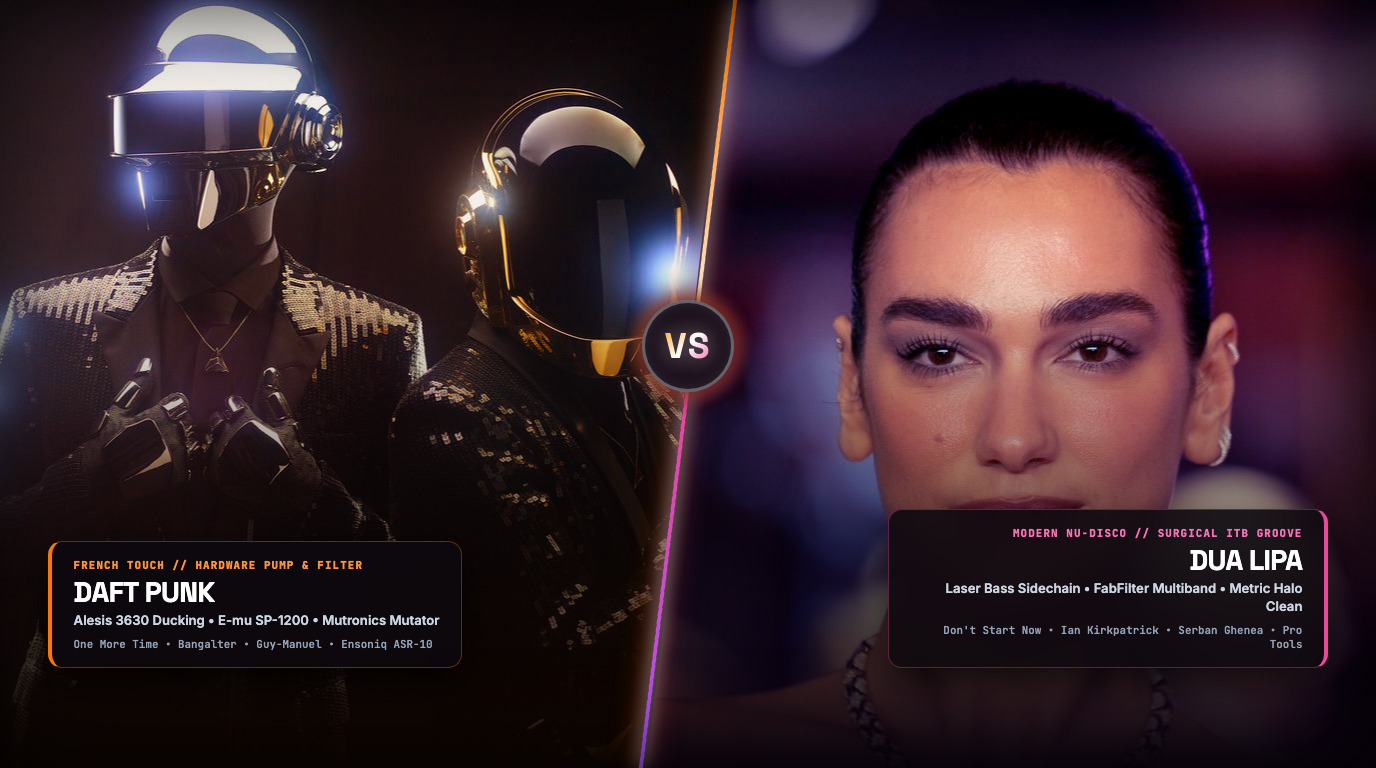
In 1997, two Parisian producers named Thomas Bangalter and Guy-Manuel de Homem-Christo transformed dance music using a piece of rack gear most professional studios threw in the trash: the Alesis 3630, a budget \$99 dual-channel VCA compressor known for ugly distortion and sluggish recovery curves. Instead of fighting those flaws, Daft Punk weaponized them. By routing an analog 909 kick drum straight into the 3630 sidechain key input while passing full-frequency vinyl disco samples through the audio channels, they forced whole mixes to gasp and swell in syncopated violent breathing. The legendary French Touch was born.
Fast forward to the 2020s. Dua Lipa's Future Nostalgia, The Weeknd's Dawn FM, and Doja Cat's global anthems rule streaming platforms worldwide. The four-on-the-floor disco rhythm is back on top, but the mechanics could not be more different. Modern Nu-Disco does not drag an entire master bus into a distorted hardware trough. Instead, modern mix engineers like Serban Ghenea and producers like Ian Kirkpatrick execute surgical split-band ducking, 64-bit floating point lookahead sidechaining, and laser-carved frequency pocketing inside the box.
Both approaches created historic dance floor anthems. But how did the production architecture evolve from a noisy rack unit into modern surgical pop perfection? Let us open the hood and break down the physics of the groove.
1. The Mechanical Schism: $99 VCA Abuse vs. Surgical ITB Floating Point
The fundamental difference between French House and Modern Nu-Disco is where gain reduction happens in the frequency spectrum:
VINTAGE FRENCH TOUCH (FULL-SPECTRUM HARDWARE PUMP):
Vinyl Loop / Master Bus -> Alesis 3630 VCA Compressor (Sidechain Key: 909 Kick) -> Master Bus Ducking (-12 dB) -> Compressed Output
result: Entire spectrum collapses together; cymbals, vocals, and bass all duck simultaneously under the kick drum

MODERN NU-DISCO (SPLIT-BAND SURGICAL ITB DUCKING):
Synth & Live Bass -> FabFilter Pro-MB Ducking (Trigger: Kick) -> Clean Sub Pocket (-8 dB <100 Hz Only) -> Pristine Unpumped Highs
result: 100 Hz+ vocals and guitars remain completely intact with zero fluttering while the sub ducks cleanly
The French Touch: Broadband VCA Smothering
When Daft Punk produced Homework (1997) and Discovery (2001), along with peers like Cassius (Philippe Zdar) and Stardust, their signal chains were ruthlessly minimalist. Samples were chopped out of 1970s vinyl on an E-mu SP-1200 (12-bit, 26.04 kHz) or an Ensoniq ASR-10. Those dirty, aliased loops were fed into a Mackie 1604 mixer and slammed into an Alesis 3630.
The Alesis 3630 had no multiband capability. When the kick fired into its sidechain input, the VCA pulled down the entire frequency range by 8 to 14 dB:
- The open hi-hats did not stay loud; they choked into silence every quarter note.
- The vocal sample was sucked down into the floorboards before rebounding on the upbeats.
- The compressor release circuit had non-linear program dependency: set to medium-fast, the release created a parabolic volume ramp that literally pulled the listener's head forward into the downbeat.
This was not transparent mixing; it was extreme dynamic distortion used as a musical instrument.

Modern Nu-Disco: Split-Band Frequency Separation
Nu-disco today honors the disco groove without sacrificing contemporary pop vocal clarity. If you choke Dua Lipa's lead vocal by 12 dB on every kick hit, modern radio programmers and playlist curators will reject the mix for lacking vocal presence.
Producers like Ian Kirkpatrick and mix engineers like Serban Ghenea isolate the sidechain trigger entirely to the low-frequency domain:
- Targeted Sub-Ducking: Using tools like FabFilter Pro-MB or Cableguys VolumeShaper, only frequencies below 120 Hz duck when the kick strikes. The sub-bass drops to minus infinity for exactly 65 milliseconds, giving the kick beater total room to punch.
- Untouched Air Bands: The Nile Rodgers-style rhythm guitars, vocal harmonies, and open hi-hats above 2 kHz never lose a single fraction of a decibel.
- Phase-Locked Lookahead: Instead of analog VCA slewing, digital lookahead (1 to 5 ms) catches the transient before it arrives, eliminating clicks and inter-sample clipping entirely.
2. The Spectrum War: Interactive A|B Curves
Compare the long-term average spectrum (LTAS) of a vintage 1998 French Touch master against a 2026 modern nu-disco production. Toggle between the curves below to inspect the frequency fingerprints:
3. The Arsenal Matrix: Rack Gear vs. Modern Plugins
The tools defining both eras represent two entirely different engineering philosophies:
| Production Category | 1990s French Touch Hardware | 2026 Modern Nu-Disco ITB Arsenal |
|---|---|---|
| Pumping / Sidechain | Alesis 3630 Hardware Compressor (\$99) | FabFilter Pro-MB / Cableguys VolumeShaper 7 |
| Sampling & Chops | E-mu SP-1200 / Ensoniq ASR-10 | Ableton Live Simpler / Serato Sample 2.0 |
| Analog Filtering | Mutronics Mutator / MAM MB33 / Ensoniq Filters | Soundtoys FilterFreak / Cytomic The Drop |
| Summing & Saturation | Mackie 1604 VLZ Console Overdrive | Slate Digital Virtual Mix Rack / Waves NLS / Softube Console 1 |
| Phaser / Modulation | Electro-Harmonix Small Stone Phase Shifter | D16 Fazortan 2 / Soundtoys PhaseMistress |
| Bass Generation | Roland Juno-106 / Minimoog Model D | Spectrasonics Trilian / U-he Diva / Real Fender Precision Bass |
| Master Bus Dynamics | DBX 160A pair into DAT Tape Machine | Weiss DS1-MK3 / FabFilter Pro-L 2 / Metric Halo ChannelStrip |
4. The Studio Showdowns: 3 Defining Mix Battles
Listen to how these technical differences play out in three iconic direct matchups. Cue the tracks on Spotify and pay close attention to the listening cues.
Vocal Chop Pumping vs. Split-Band Groove Pocketing
Contrast Daft Punk's saturated bus choking with Serban Ghenea's laser-carved nu-disco separation.

- 0:25 When the brass sample drops, hear how the entire soundstage ducks and recovers behind the kick drum. The horn reverb tail is physically dragged down every downbeat.
- 1:30 Romanthony's Auto-Tuned vocal gets swallowed into the same compressor bus as the drums, creating a unison pumping groove where vocal and kick behave as one instrument.

- 0:14 The bassline drops: sub frequencies under 90 Hz duck cleanly for the kick, while the mid-range bass fret clack at 1.5 kHz never ducks, keeping the bounce snappy.
- 0:45 Full chorus explosion: Dua Lipa's vocal floats completely untouched above the rhythm section. Zero pumping artifacts, zero gain modulation on her sibilance.
Chaka Khan Vinyl Loop vs. Max Martin Pop Engineering
Discover how three bars of 1981 disco vinyl sparked a French cultural phenomenon, compared to modern synth-pop precision.

- 0:08 Listen to the 2-bar guitar loop sampled from Chaka Khan's 'Fate'. The vinyl surface crackle is compressed so aggressively that the dust pops create rhythmic percussion.
- 1:05 The phaser sweeps across the master bus. Because the phaser sits before the 3630 compressor, the resonant filter peaks trigger deeper gain reduction, altering the groove.

- 0:12 The 16th-note rhythm guitar riff is inspired by French Touch, but every transient is pristine. Transient shaping keeps the pick attack uniform across the stereo field.
- 0:52 The four-on-the-floor kick pushes the low end with zero overhang. When the bass drops out for 2 beats, the room reverb tail stays silky rather than swelling unnaturally.
Chic Sample Filtering vs. High-Gloss R&B Funk
Compare Modjo's sweeping resonant analog low-pass filter with Doja Cat's crystalline, radio-primed gloss.
- 0:01 The opening guitar loop (sampled from Chic's 'Soup for One') is band-passed down to 800 Hz. Notice how the resonance screams slightly right before opening to full frequency.
- 1:15 The bass guitar is heavily compressed with an analog opto circuit, providing thick low-mid warmth (200 Hz) that anchors the track without requiring modern sub-bass.

- 0:04 The Nile Rodgers-style clean guitar sits far out on the stereo wings (panned 100% L and R), leaving the exact center 100% open for the dry kick and intimate lead vocal.
- 0:47 During the rap verse, the bassline carries the dynamic bounce without any master-bus ducking. The sidechain is restricted exclusively to the kick-to-bass relationship.
5. Producer Playbook: 5 Groove Engineering Laws
Whether you want vintage French grit or modern pop sheen, apply these five foundational engineering rules to your sessions:
1. Match Sidechain Release to Track BPM
Never set compressor release times by eye. Use this exact formula to synchronize your compressor recovery with your project tempo:
At 124 BPM, a quarter note is 483.8 ms. For authentic French House pump, you want the compressor to release over an eighth note (241.9 ms) or a dotted sixteenth (181.4 ms). If the compressor releases too quickly, you get ugly distortion. If it releases too slowly, the groove chokes and misses the next beat.
2. Isolate Ducking Below 120 Hz for Modern Vocals
If your track features a pop vocal, do not place a sidechain compressor on the mix bus. Insert a dynamic EQ (like FabFilter Pro-Q 3) on the bass track, engage an external sidechain triggered by the kick, and set a bell filter at 55 Hz to duck 6 to 9 dB with a Q of 1.4. Your kick punches through cleanly while your guitars, synths, and vocals remain completely stable.
3. Emulate 12-Bit Aliasing Before the Filter
The warm mojo of the French Touch came from running low-bitrate samplers into analog low-pass filters. Recreate this in your DAW:
- Insert a bitcrusher on your disco sample loop.
- Set wordlength to 12 bits and sample rate down to 26 kHz.
- Follow the bitcrusher immediately with a 24 dB/octave analog-modeled ladder filter (like Soundtoys FilterFreak).
- Sweep the cutoff down from 12 kHz to 400 Hz for authentic vintage breakdowns.
4. Drive Your Drum Bus Pre-Limiter
Daft Punk did not use brickwall digital limiters; they drove the analog line inputs of their Mackie console until the operational amplifiers saturated smoothly. In your DAW, place a soft-clipper (like Spoon Sound Clip-Zero or Bite Harder) on your drum bus. Shave 2 to 3 dB off the kick and snare transient peaks before the audio hits your master limiter. This increases perceived loudness without muddying the mix.
5. Carve the 250 Hz Frequency Pocket
Disco basslines and four-on-the-floor kick drums constantly battle in the 200 to 300 Hz octave. If both instruments occupy that zone, your track turns to muddy cardboard. Decide which element owns the low-mids:
- If your kick drum has a heavy 200 Hz chest knock, scoop your bass guitar by 3 dB at 220 Hz.
- If your bassline carries melodic harmonics at 250 Hz, use a tight sub-kick (fundamental at 50 Hz, steep cut at 200 Hz) to give the bass complete melodic freedom.
6. Producer Cheat Sheet: Vintage Touch vs. Modern Gloss
Keep this parameter reference on hand during your next production session:
| Engineering Parameter | French House (Daft Punk / Cassius) | Modern Nu-Disco (Dua Lipa / The Weeknd) |
|---|---|---|
| Kick Fundamental | 65 Hz to 75 Hz (Punchy 909 / Vintage Vinyl) | 45 Hz to 55 Hz (Deep synthesized sub weight) |
| Bassline Architecture | Mono sampled disco loop or Juno-106 sub | Layered: Clean sine sub + Stereo live bass clack |
| Sidechain Range | Full frequency band (Broadband VCA pull) | Low-band only (20 Hz to 120 Hz split ducking) |
| Sidechain Gain Reduction | -8 dB to -14 dB (Deliberately exaggerated) | -4 dB to -7 dB (Transparent transient clearance) |
| High Frequency Profile | Steep low-pass filter rolloff above 13 kHz | Wide air-band boost at 12 kHz to 16 kHz |
| Summing Saturation | Mackie 1604 console overdrive + cassette | Clean 64-bit float summing with tape plugin color |
| Stereo Imaging | Narrow center-focused grooves, mono sub | Ultra-wide side guitars (100% L/R), mono sub |
| Integrated Loudness | -10 to -8 LUFS (Unconstrained peak punch) | -8 to -6 LUFS (Competitive streaming master) |
7. The Modern 2026 Hybrid Pipeline
You do not have to choose between French Touch swagger and modern pop clarity. Here is the step-by-step 2026 hybrid workflow that gives you the best of both worlds:
THE 2026 FRENCH NU-DISCO HYBRID PIPELINE:
Phase 1: Sample Texture (12-bit sampler crunch at 28 kHz & tape saturation) -> Phase 2: Resonant Low-Pass Filter (24 dB/oct sweep with +1.5 dB resonance) -> Phase 3: Split-Band Sidechain Ducking (-8 dB below 120 Hz keyed to kick) -> Phase 4: Master Bus Saturation & True-Peak Limiter (-0.3 dBTP, 4x oversampling)
result: Authentic vintage French Touch harmonic attitude with modern competitive pop low-end clarity- Step 1: The Sample Texture Chain: Load your disco guitar or chord sample into your sampler. Insert a bitcrusher set to 12-bit depth and 28 kHz sample rate. Add an analog tape saturation plugin to soften the harsh transients.
- Step 2: Resonant Filter Sweeping: Insert a 24 dB/octave resonant low-pass filter plugin with MIDI envelope control. Automate the filter cutoff to open on phrase transitions, adding 1.5 dB of filter resonance at the cutoff frequency to mimic a Mutronics Mutator.
- Step 3: Split-Band Sidechain Setup: Place a multiband compressor or dynamic EQ on your sample bus and bass track. Route your kick drum to the sidechain input. Configure the plugin to duck only frequencies below 120 Hz by 8 dB, with a 1 ms attack and a tempo-synced eighth-note release.
- Step 4: Master Bus Saturation Polish: On your master channel, place a high-end console saturation emulation followed by a transparent true-peak limiter. Set your limiter ceiling to -0.3 dBFS with 4x oversampling engaged to prevent inter-sample peaks during streaming compression.
The French Touch taught producers that dynamic pumping can be used as emotional percussion. Modern Nu-Disco proved that surgical precision can turn that same groove into platinum chart-toppers. Combine both, and your productions will hit the sweet spot between raw attitude and modern polish.